
Structured Workplace Mentoring Programme (SWMP)
What is it?
The Law Society’s Structured Workplace Mentoring Programme (“SWMP”) aims to strengthen professional development for junior lawyers through structured, meaningful mentorship by senior lawyers from the same law practice.
The programme is accompanied by a syllabus (“SWMP syllabus”) which has been specially curated to address some of the key issues and challenges that a junior lawyer may encounter in his or her early years of practice, including the interface between legal practice and issues of ethics and professional standards.
The SWMP syllabus is a mentoring resource that law practices can adapt and use in developing their own structured mentorship programmes to best fit the professional development needs of their junior lawyers.
Why SWMP?
In its final report dated 8 January 2025 (“EPSC Final Report”), the Ethics and Professional Standards Committee (“EPSC”) recommended, among other measures, that the Law Society develop a syllabus for a structured mentoring programme within law firms which law firms can adapt for their use, the contents of which are to focus on topics corresponding to the core areas of law firm management and other issues covered in the syllabus of the expanded Legal Practice Management Course (“LPMC”).
In summary, the rationale given by the EPSC was as follows:
- A key aspect of the concept of a community in the context of the legal industry is mentorship. Mentorship is an essential part of a lawyer’s formation that all junior lawyers should actively cultivate and demand.
- Mentorship has always been a vital element of the training and development of young lawyers, serving as a bridge between legal education and practice.
- In a survey conducted in 2024 of more than 500 lawyers who had between 2 to 10 years of PQE, the EPSC found that while an overwhelming majority regarded mentorship as a key enabler to a conducive working environment, only one in ten had participated in a structured mentorship programme.
- While mentoring can happen organically, its benefits are too important to leave to chance. Structured programmes like SWMP create intentional opportunities for mentoring relationships to flourish.
What does the SWMP cover?
SWMP is organised around three mentoring programme areas, mapped closely to law firm management and the expanded LPMC syllabus:
- Core Values of the Legal Profession
- Integrity, Professionalism, Justice
- Safe & Sustainable Workplaces
- Preventing workplace harassment and bullying; adopting sustainable practices for long-term sustainability in legal practice.
- Practice Management
- Client confidentiality, conflicts, AML/CFT/CPF, client intake and file/case management, communications, client money, use of technology, supervision of staff, and undertakings.
The SWMP Syllabus comprises the following topics:
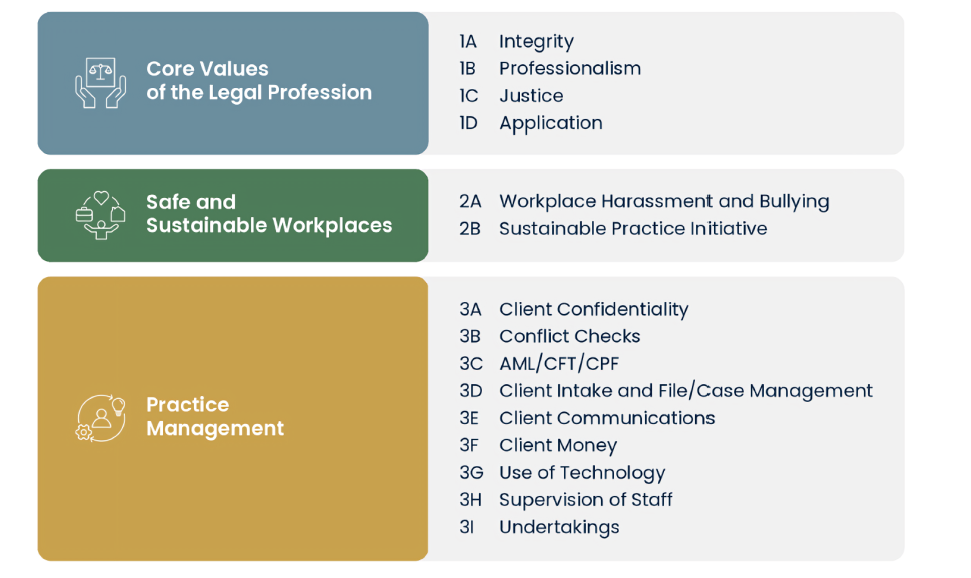
| No. | Programme Area | Section Code | Section Title |
|---|---|---|---|
| 1. | Core Values of the Legal Profession | 1A | Integrity |
| 1B | Professionalism | ||
| 1C | Justice | ||
| 1D | Application | ||
| 2. | Safe and Sustainable Workplaces | 2A | Workplace harassment and bullying |
| 2B | Sustainable practice initiative | ||
| 3. | Practice Management | 3A | Client confidentiality |
| 3B | Conflict checks | ||
| 3C | AML/CFT/CPF | ||
| 3D | Client intake and file/case management | ||
| 3E | Client communications | ||
| 3F | Client money | ||
| 3G | Use of technology | ||
| 3H | Supervision of staff | ||
| 3I | Undertakings |
How Does It Work?
- Content Coverage Requirements
- Mentoring pairs are to complete six (6) sections per Mentoring Year, with at least one (1) section from each programme area. The syllabus spans two (2) Mentoring Years—a total of twelve (12) sections—with remaining sections completed in a third Mentoring Year or via the firm’s own onboarding/internal training programmes.
- Progress can be tracked using a Mentorship Checklist.
- Mentoring Session Design
- Mentors (and their law practices) have full flexibility to design the mentorship sessions according to their needs and capabilities. Sessions may be conducted individually or in a group setting involving multiple mentors and mentees.
- It is recommended that mentors hold at least three (3) sessions during each Mentoring Year, with each session lasting between 30 minutes and 1 hour (excluding breaks). This is to ensure sufficient time to cover the six (6) Sections for each Mentoring Year.
- Mentoring pairs may cover the six (6) Sections for each Mentoring Year in any sequence they prefer. Multiple Sections from the same Programme Area can be covered in a single session if convenient.
- Practical Conversations
- Mentors are encouraged to share and discuss their law practice’s internal protocols and personal experiences with mentees during the mentoring sessions.
Can I earn CPD Points?
Mentoring sessions can be structured as in-house seminars or small group discussions per the relevant Singapore Institute of Legal Education’s (SILE) CPD (Continuing Professional Development) Guide, allowing mentors and mentees in the same firm to obtain Private CPD Points, subject to SILE’s approval.
How does SWMP help?
For Junior Lawyers:
- A deeper understanding of the profession’s core values and how they shape daily decisions.
- Practical, inside-the-firm insights into practice management essentials (conflicts, confidentiality, AML/CFT/CPF, client money, technology use, supervision, undertakings) and a greater understanding of their firm’s internal protocols.
- Tools and habits to build healthy, sustainable careers in law, including strategies to prevent harassment and to promote collegial practice.
For Law Practices:
- A ready-to-use syllabus and checklist to standardise mentoring within the firm.
- Stronger adherence to firm protocols and ethical best practices by juniors, with organisational and systemic benefits.
- A culture that models and reinforces professionalism, well-being, and quality standards across teams.
How do I get started?
- Identify mentors and mentees for the upcoming Mentoring Year.
- Select six (6) sections—ensuring at least one from each programme area—and schedule three sessions (30–60 minutes).
- Download the SWMP workbook (containing the SWMP syllabus)
- Download and use the Mentorship Checklist to track coverage and sign-offs.
- Integrate firm protocols (e.g., conflicts systems, confidentiality and data policies, AML frameworks) into the discussions.
- Consider CPD accreditation by aligning sessions with SILE’s in-house or small-group formats.
How can I be a mentor?
The Law Society has introduced mentorship training for participants of the expanded LPMC and will continue to support rising partners and law practice owners to become effective mentors.
Where can I find out more?
For an introductory article on the SWMP, please view Introducing the Law Society’s Structured Workplace Mentoring Programme – The Singapore Law Gazette (December 2025).
You may download the SWMP Workbook (containing the SWMP syllabus) via this link.
Access our specially prepared SWMP video resources via this link.
For enquiries or feedback, please contact the Knowledge Management Department at km@lawsoc.org.sg.