What is Mediation?
Mediation is a private dispute resolution process where parties agree to refer their dispute to a mediator. It is often a cheaper and more efficient alternative to litigation and allows for disputing parties to preserve their relationship after the process.
- All types of civil disputes are suitable for mediation under the Law Society Mediation Scheme (‘LSMS’) and there is no monetary limit for a civil dispute to be mediated under the LSMS.
- Any mediation settlement agreement entered into between the parties is binding, if it is in writing and signed by the parties.
- Although the mediator is a neutral third party to the mediation process, the mediator is not an arbiter and does not make any decisions on behalf of the parties.
For a mediation to commence under the LSMS, all parties must agree to mediate the dispute under the LSMS.
Details on how to procure all parties’ agreement
Mediation is a private dispute resolution process where parties agree to refer their dispute to a mediator. An agreement to mediate a dispute under the Law Society Mediation Scheme (‘LSMS’) can be reached through, but not limited to, the following 4 methods:
- Through an agreement entered into before a dispute arises, to refer that dispute to mediation.
Parties who desire to mediate any dispute arising under a contract may insert into the contract a mediation clause in the following terms:
“All disputes, controversies or differences (‘dispute’) arising out of or in connection with this contract, including any questions regarding its existence, validity or termination, shall first be referred to mediation in Singapore, in accordance with the Law Society Mediation Rules for the time being in force.”
- Through an agreement entered into after a dispute arises, to refer that dispute to mediation.
Parties who do not have an existing mediation agreement in their underlying contract may agree to mediate under the LSMS after a dispute arises.
Please click here to access a sample agreement to mediate.
- Through an agreement to refer the dispute for mediation entered into during court or arbitration proceedings.
- Together with the Law Society Arbitration Scheme, through a multi-tiered dispute resolution clause in an agreement entered into before or after the dispute arises.
Parties may insert into the contract a mediation-arbitration clause in the following terms:
“All disputes, controversies or differences (‘dispute’) arising out of or in connection with this contract, including any questions regarding its existence, validity or termination, shall first be referred to mediation in Singapore, in accordance with the Law Society Mediation Rules for the time being in force. In the event that the dispute cannot be resolved in mediation within the time agreed by the parties, the parties shall refer the dispute to arbitration in Singapore in accordance with the Law Society Arbitration Scheme and the rules thereunder for the time being in force.”
Benefits of the LSMS
- SIMI Accredited: The LSMS is a registered service provider fully accredited by the Singapore International Mediation Institute (“SIMI”).
- Cost and time-saving: Mediations under the LSMS are expected to be quick and efficient. The LSMS adopts a friendly fee structure for parties who are looking to arrive at a quick, cost-effective and mutually acceptable dispute resolution.
- Control over outcomes: The LSMS allows for parties to be directly involved in the decision making process. Parties are free to agree how, and in what form, they will present or inform the mediator of their case.
- Confidentiality: Mediation sessions under the LSMS are private and confidential. All mediation communications can only be disclosed with the consent of the party who made the communication. There is no formal record or transcript of the mediation.
- Highly Professional: The LSMS panel of mediators consists of experienced, accredited practitioners with industry-specific knowledge who have satisfied the minimum criterion set out by the Law Society of Singapore.
The LSMS Panel of Mediators
Where parties mediate under the LSMS, they can only choose mediators from the LSMS Panel of Mediators (‘Panel’). The Panel is divided into the categories of ‘Senior Mediator’ and ‘Associate Mediator’.
- The President of the Law Society of Singapore will appoint two Associate Mediators from the LSMS Panel of Mediators to mediate the dispute where the value of the claim is up to S$60,000.
- Where the value of the claim is more than S$60,000, the President will appoint a Senior Mediator and an Associate Mediator from the LSMS Panel of Mediators to mediate the dispute. The Senior Mediator will conduct the Mediation with the assistance of the Associate Mediator.
All mediators from the Panel are experienced lawyers who have satisfied the minimum criteria of mediator accreditation and mediation experience set by the Law Society of Singapore.
Mediations conducted within the LSMS may also be used by our mediators for advancement to SIMI Accredited Mediator Levels 2 or 3.
For the list of our mediators, please click here.
Fees
The Fees Schedule of the Law Society Mediation Rules sets out the following the administrative charges and mediation fees when parties engage in mediation under the LSMS.
To access the latest Fees Schedule, please click here.
Apply for Mediation
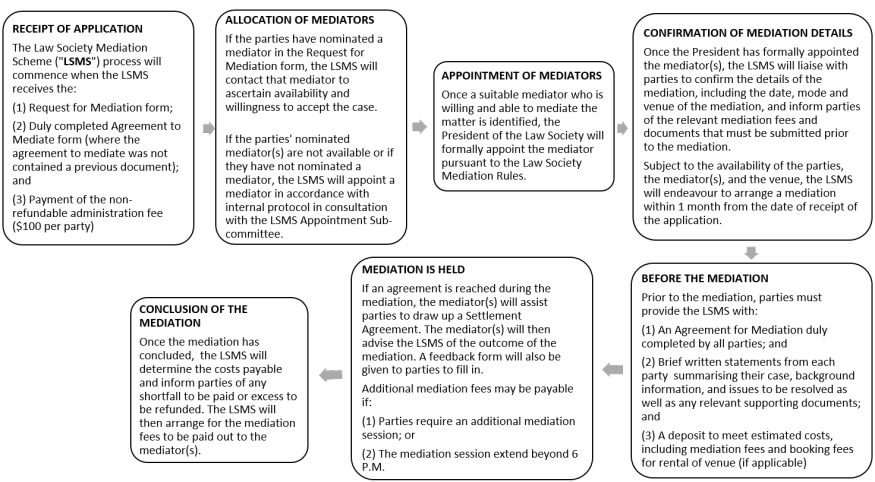
To apply for Mediation under the LSMS, please click here.
To access the necessary forms and resources, please click here.
Frequently Asked Questions
For a list of frequently asked questions on the LSMS, please click here.
Contact Us
For queries on the LSMS, please e-mail adr@lawsoc.org.sg.
Alternatively, you may wish to contact us using the Contact Us page.